ROSMARY
Botanical classification
Plant kingdom
Subkingdom Tracheobionta (vascular plant)
Division Magnoliophyta (ex Angiospermae)
Class Magnoliopsida (ex Dicotyledones)
Subclass Asteridae
Order Lamiales
Family Lamiaceae (ex Labiatae)
Gender Rosmarinus
Species Rosmarinus officinalis
|
 |
The general Characteristics of Rosmary
Rosmary belongs to the Rosmarinus genus, of the Lamiaceae family and its scientific name is
Rosmarinus officinalis. Originating from the Mediterranean area it can be found growing spontaneously along the coast at up to 1500 meters above sea level. It is a perennial shrub growing into a bush which can reach up to 3 meters in height.
|
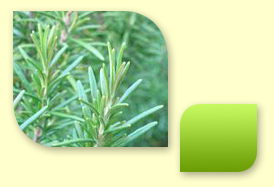
At the beginning the stem of the Rosemary is prostrate but then becomes erect and has many twigs. The roots grow deep and anchor themselves tenaciously in the earth. It has straight, slim pointed leaves which are slightly tough and stalkless. They grow in great quantity along the branches and are rich in oil glands.
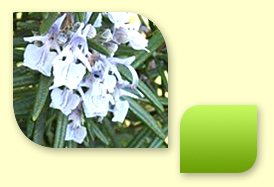
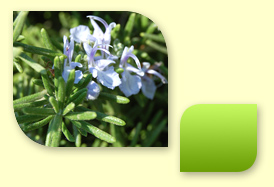
The light-blue, violet flowers are bunched together at the axil of the leaves and are present nearly all the year round. They are hermaphrodites and pollination is carried out above all by bees which feast themselves on their nectar thus producing a delicious honey. The fruits are achene which darken when ripe.
|
 |
Rosmarinus officinalis is the only plant in the Rosmarinus genus, however numerous varieties exist which differ only for the intensity of their aromas and for their different ways of growth.
Rosmarinus officinalis prostratus, is one of these, being very popular as an ornamental plant because, as its latin name indicates, it grows near and tends to cover the ground.
|
 |
Aromatic properties
Rosmary is rich in essential oil which is responsible for its characteristic aroma made up of pinene, conforene, limonene, flavonoids, phenolic acids, tannins, resins, canphora e rosmarinic acid.
Harvesting and preserving
Both leaves and flowers are used, being harvested when the plant is in full bloom during the Summer. The sprigs with flowers are dried immediately after being gathered, hung with their heads down in a shady, airy place to avoid losing any of their characteristics. Once dried, the leaves and flowers are separated from the twigs and kept in sealed glass jars. However, Rosemary is best used fresh as it loses a great deal of its properties when dried. Only the fresh flowered tops are used for the production of the essential oils.
|
| |
|
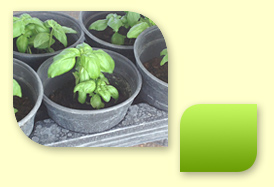
BASIL IN VASES
Ardizzona Srl also produces, small plants of basil in vases for retail and large scale distribution.
|
 |
FLORAL COMPOSITIONS |
|
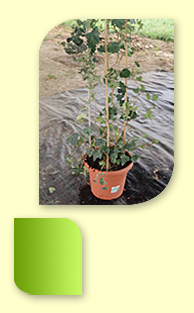
TOTEM
Created on a structure of bamboo cane and Ivies of different species.
 |
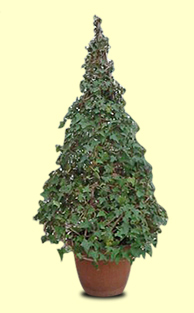
IVY CONES
manufactured metal support and bamboo canes tied together in the form of a cone. They are used with Ivies of different heights:
- small (H 50 cm)
- medium (H 120 cm)
- big (H 170 cm)
 |
.